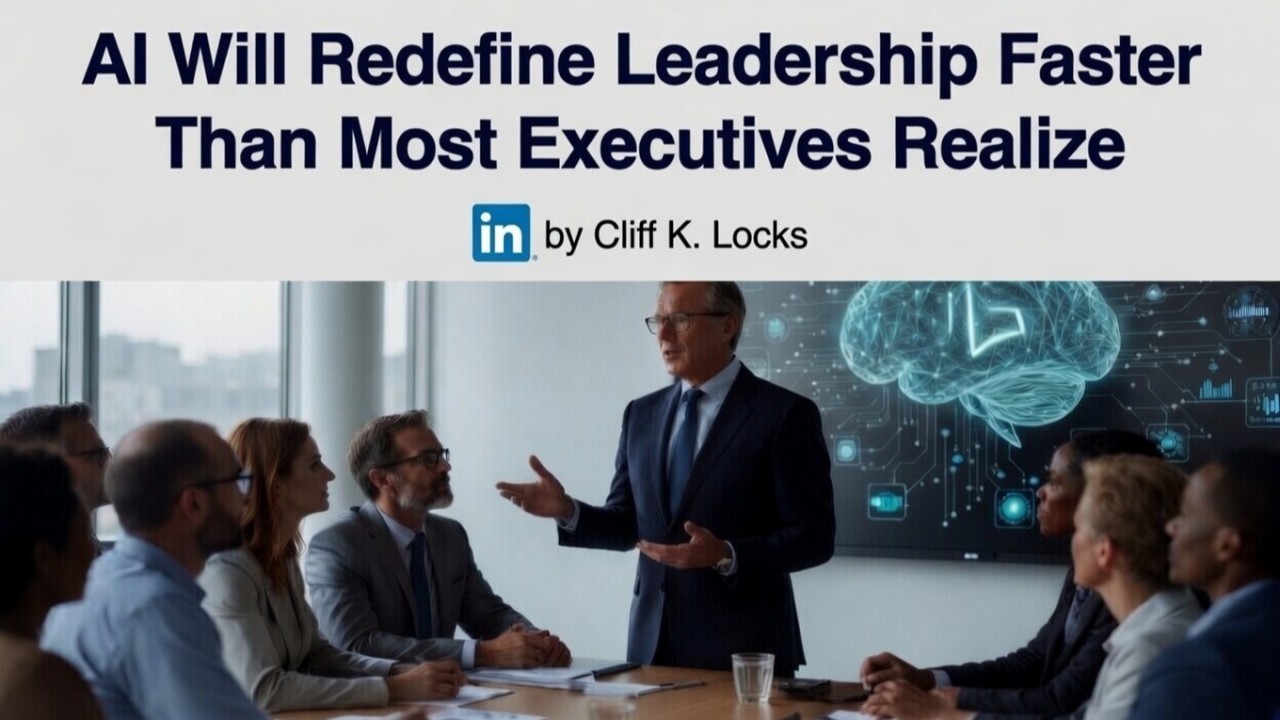
AI Will Redefine Leadership Faster Than Most Executives Realize
Many executives still view AI as another technology initiative that can be delegated to innovation teams, consultants, or IT departments. That mindset is rapidly becoming outdated.
Artificial intelligence is not simply another software upgrade. It represents a structural shift in how organizations create value, make decisions, manage talent, compete in markets, and scale operations.
The companies that recognize this early are already gaining advantages in:
- Operational speed
- Customer personalization
- Predictive decision-making
- Talent productivity
- Data analysis
- Innovation cycles
- Market responsiveness
Organizations that move slowly may find themselves competing against businesses operating at dramatically higher efficiency levels with lower costs and faster execution.
This is why leadership involvement matters more than ever.
AI Is Becoming a Leadership Discipline, Not Just a Technology Function
Historically, many executives delegated digital transformation to technical teams. AI changes that equation because it directly impacts:
- Strategic planning
- Organizational structure
- Workforce design
- Customer experience
- Revenue generation
- Competitive positioning
- Risk management
Leaders who personally engage with AI tools often develop stronger strategic insight into where opportunities exist inside their organizations.
Executives who experiment firsthand begin to recognize:
- Where inefficiencies exist
- Which repetitive workflows can be automated
- How employees can become more productive
- Where customer experiences can improve
- How knowledge can move faster throughout the company
This creates an entirely different level of strategic awareness compared to organizations where leadership remains disconnected from the technology.
The Organizations Winning With AI Are Building Learning Cultures
One of the most overlooked realities about AI adoption is that no company has all the answers yet.
The market is evolving rapidly. AI models continue improving. New tools emerge constantly. Workflows that seemed impossible six months ago are becoming standard operating procedures.
The businesses pulling ahead are not necessarily the ones with the largest budgets. Often, they are the organizations building the fastest learning loops.
High-performing AI-driven organizations encourage:
- Rapid experimentation
- Cross-functional collaboration
- Knowledge sharing
- Continuous training
- Open discussion of failures and lessons learned
- Agile decision-making
Employees should feel empowered to test new workflows responsibly and share results internally.
This creates momentum throughout the organization instead of limiting AI adoption to isolated departments.
AI Will Elevate the Importance of Human Judgment
There is growing concern about automation replacing jobs, and some disruption is inevitable. However, many executives misunderstand where long-term value creation will come from in an AI-driven economy.
As AI automates repetitive and process-driven work, uniquely human capabilities become more valuable:
- Strategic thinking
- Emotional intelligence
- Leadership
- Creativity
- Relationship building
- Ethical judgment
- Negotiation
- Vision casting
- Decision-making under uncertainty
AI can generate information quickly, but human leaders still determine:
- Which opportunities matter most
- What risks are acceptable
- How organizations should allocate resources
- How culture should evolve
- What ethical boundaries should exist
- How customer trust is maintained
The future workforce will likely consist of professionals augmented by AI rather than replaced entirely by it.
The Next Generation of Employees Will Work Differently
Entry-level roles are already beginning to change.
Historically, junior employees often handled:
- Administrative work
- Basic analysis
- Research tasks
- Documentation
- First-draft content creation
- Data organization
AI systems can now perform many of these functions faster and at lower cost.
This means future professionals will need stronger skills in:
- Problem-solving
- AI collaboration
- Communication
- Critical analysis
- Decision framing
- Business judgment
- Strategic interpretation
The ability to ask better questions may become more valuable than memorizing information.
Educational institutions and corporate training programs will need to evolve quickly to prepare talent for these changes.
Competitive Advantage Will Come From Integration, Not Just Access
As AI becomes widely available, access alone will not create sustainable differentiation.
Competitive advantage will increasingly come from how organizations combine AI with:
- Proprietary data
- Industry expertise
- Customer trust
- Brand reputation
- Operational execution
- Strategic partnerships
- Organizational agility
Companies that deeply integrate AI into their processes and decision-making systems will outperform organizations using AI superficially.
Adding a chatbot to an outdated process is not transformation.
Reimagining how the business operates from the ground up is where the real opportunity exists.
AI Governance Must Balance Innovation and Protection
Responsible AI adoption requires clear governance structures.
Leaders must balance innovation with safeguards that protect:
- Customer data
- Intellectual property
- Regulatory compliance
- Cybersecurity
- Brand reputation
- Ethical standards
Strong AI governance should include:
- Clear usage policies
- Human oversight
- Security controls
- Employee training
- Risk monitoring
- Transparency standards
- Accountability frameworks
However, organizations should avoid creating so much bureaucracy that innovation becomes impossible.
The most successful companies will find ways to move quickly while maintaining appropriate safeguards.
The Long-Term Winners Will Be Adaptive Organizations
One of the most important realities about AI is that the technology will continue evolving at extraordinary speed.
Many current limitations will improve significantly over the next several years.
Organizations waiting for perfect certainty before acting may fall far behind competitors already building internal expertise and operational experience.
The businesses best positioned for long-term success will:
- Learn continuously
- Adapt quickly
- Encourage experimentation
- Empower employees
- Invest in leadership development
- Stay strategically flexible
AI transformation is not a one-time project. It is an ongoing evolution.
The Leadership Responsibility Ahead
The next decade will likely produce one of the largest business transformations in modern history.
Some organizations will resist change and slowly lose relevance.
Others will proactively embrace AI while strengthening leadership, culture, ethics, and operational excellence.
The strongest leaders will not simply ask:
- “How do we use AI?”
They will ask:
- “How do we build a stronger, smarter, more adaptive organization because of AI?”
That shift in thinking may ultimately determine which businesses lead the future economy.
Follow Cliff K. Locks on LinkedIn for strategic insights on leadership and a clear, forward-looking view of the future. Available for Board of Directors and Advisory roles, bringing strategic insight, operational experience, and leadership perspective. Cliff K. Locks LinkedIn
#ArtificialIntelligence #LeadershipDevelopment #ExecutiveLeadership #FutureOfBusiness #InnovationStrategy #DigitalTransformation
Cliff K. Locks, an accomplished mentor and executive coach with extensive experience in board leadership, corporate governance, and strategic guidance, is available for an additional board role as an independent, trusted board member. With a proven track record of supporting company growth and navigating complex challenges, Cliff brings valuable insights and dedicated bandwidth to contribute to a Board of Directors or Board of Advisors. His expertise makes him a vital asset for organizations seeking to enhance governance and make informed, forward-thinking decisions. Let’s talk; here is my calendar.
Build your business and leadership skills with business consulting from Investment Capital Growth. For affordable training in the Emerging Leaders Program and Executive Leadership Academy, avail yourself of the self-paced training courses, which now include live mentorship, through Zoom.
Recent Blog Post: From Challenges to Foresight: How Data-Driven Leaders Turn Setbacks into Strategic Advantage
Contributor: Cliff K. Locks, CEO | COO | Executive Consultant and Mentor | Board of Directors | Governance | Private Equity Podcast Host | Reverse Logistics | Supply Chain | Advisory Board | SaaS | Clean Tech | Med Tech | Agentica AI Agents
comment off Click here to read/write comments